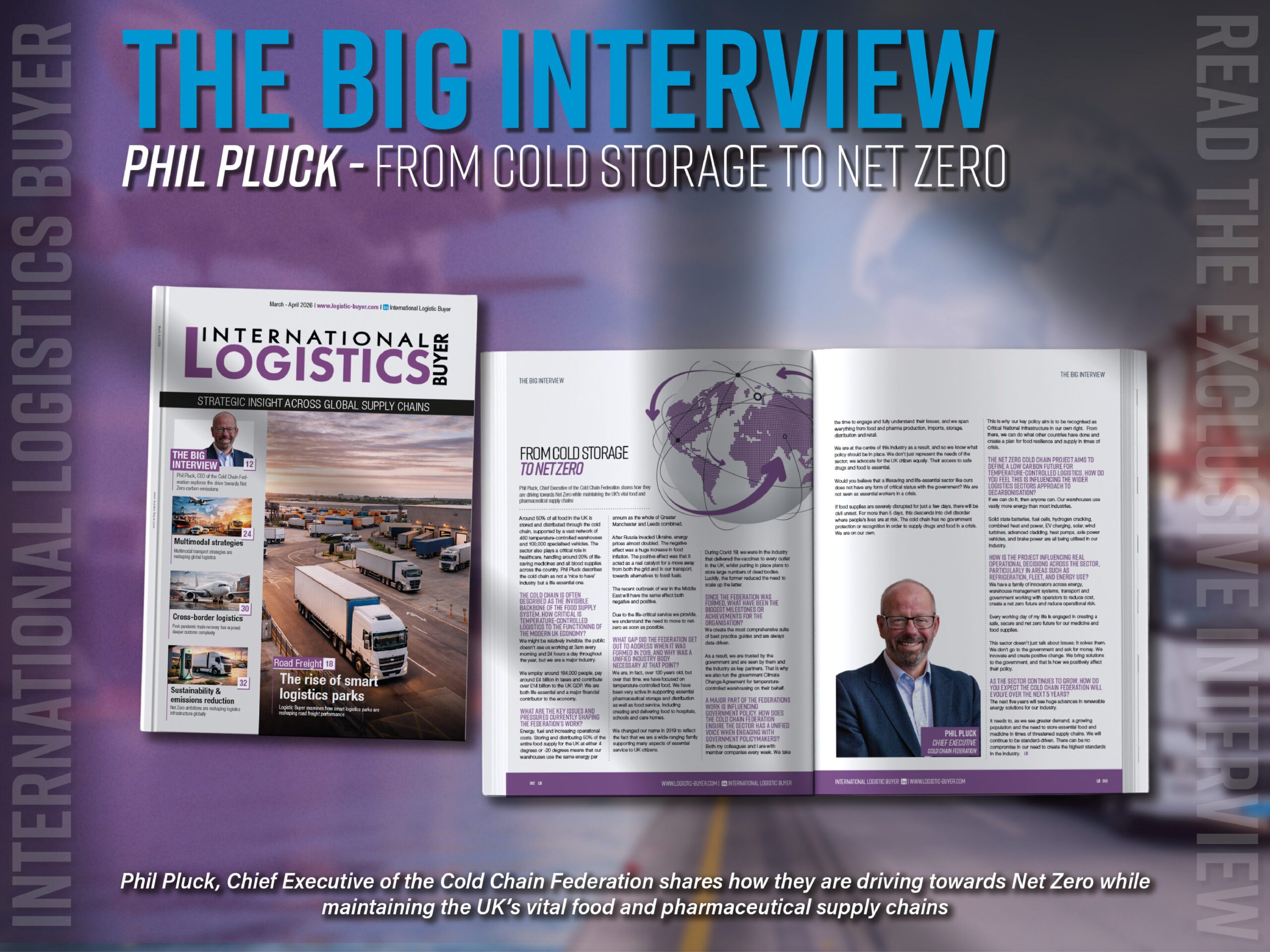

Phil Pluck, Chief Executive of the Cold Chain Federation shares how they are driving towards Net Zero while maintaining the UK’s vital food and pharmaceutical supply chains.
Around 50% of all food in the UK is stored and distributed through the cold chain, supported by a vast network of 460 temperature-controlled warehouses and 100,000 specialised vehicles. The sector also plays a critical role in healthcare, handling around 20% of life-saving medicines and all blood supplies across the country. Phil Pluck describes the cold chain as not a ‘nice to have’ industry but a life essential one.
The cold chain is often described as the invisible backbone of the food supply system. How critical is temperature-controlled logistics to the functioning of the modern UK economy?
We might be relatively invisible; the public doesn’t see us working at 3am every morning and 24 hours a day throughout the year, but we are a major industry.
We employ around 184,000 people, pay around £4 billion in taxes and contribute over £14 billion to the UK GDP. We are both life essential and a major financial contributor to the economy.
What are the key issues and pressures currently shaping the Federation’s work?
Energy, fuel and increasing operational costs. Storing and distributing 50% of the entire food supply for the UK at either 4 degrees or -20 degrees means that our warehouses use the same energy per annum as the whole of Greater Manchester and Leeds combined.
After Russia invaded Ukraine, energy prices almost doubled. The negative effect was a huge increase in food inflation. The positive effect was that it acted as a real catalyst for a move away from both the grid and in our transport, towards alternatives to fossil fuels.
The recent outbreak of war in the Middle East will have the same effect both negative and positive.
Due to the life-critical service we provide, we understand the need to move to net-zero as soon as possible.
What gap did the Federation set out to address when it was formed in 2019, and why was a unified industry body necessary at that point?
We are, in fact, over 120 years old, but over that time, we have focused on temperature-controlled food. We have been very active in supporting essential pharmaceutical storage and distribution as well as food service, including creating and delivering food to hospitals, schools and care homes.
We changed our name in 2019 to reflect the fact that we are a wide-ranging family supporting many aspects of essential service to UK citizens.
During Covid 19, we were in the industry that delivered the vaccines to every outlet in the UK, whilst putting in place plans to store large numbers of dead bodies. Luckily, the former reduced the need to scale up the latter.
Since the federation was formed, what have been the biggest milestones or achievements for the organisation?
We create the most comprehensive suite of best practice guides and are always data-driven.
As a result, we are trusted by the government and are seen by them and the industry as key partners. That is why we also run the government Climate Change Agreement for temperature-controlled warehousing on their behalf.
A major part of the Federations work is influencing government policy. How does the Cold Chain Federation ensure the sector has a unified voice when engaging with government policymakers?
Both my colleagues and I are with member companies every week. We take the time to engage and fully understand their issues, and we span everything from food and pharma production, imports, storage, distribution and retail.
We are at the centre of this industry as a result, and so we know what policy should be in place. We don’t just represent the needs of the sector; we advocate for the UK citizen equally. Their access to safe drugs and food is essential.
Would you believe that a lifesaving and life-essential sector like ours does not have any form of critical status with the government? We are not seen as essential workers in a crisis.
If food supplies are severely disrupted for just a few days, there will be civil unrest. For more than 5 days, this descends into civil disorder where people’s lives are at risk. The cold chain has no government protection or recognition in order to supply drugs and food in a crisis. We are on our own.
This is why our key policy aim is to be recognised as Critical National Infrastructure in our own right. From there, we can do what other countries have done and create a plan for food resilience and supply in times of crisis.
The Net Zero Cold Chain Project aims to define a low carbon future for temperature-controlled logistics. How do you feel this is influencing the wider logistics sectors approach to decarbonisation?
If we can do it, then anyone can. Our warehouses use vastly more energy than most industries.
Solid state batteries, fuel cells, hydrogen cracking, combined heat and power, EV charging, solar, wind turbines, advanced cladding, heat pumps, axle power vehicles, and brake power are all being utilised in our industry.
How is the project influencing real operational decisions across the sector, particularly in areas such as refrigeration, fleet, and energy use?
We have a family of innovators across energy, warehouse management systems, transport and government working with operators to reduce cost, create a net zero future and reduce operational risk.
Every working day of my life is engaged in creating a safe, secure and net zero future for our medicine and food supplies.
This sector doesn’t just talk about issues; it solves them. We don’t go to the government and ask for money. We innovate and create positive change. We bring solutions to the government, and that is how we positively affect their policy.
As the sector continues to grow, how do you expect the Cold Chain Federation will evolve over the next 5 years?
The next five years will see huge advances in renewable energy solutions for our industry.
It needs to, as we see greater demand, a growing population and the need to store essential food and medicine in times of threatened supply chains. We will continue to be standard-driven. There can be no compromise in our need to create the highest standards in the industry.