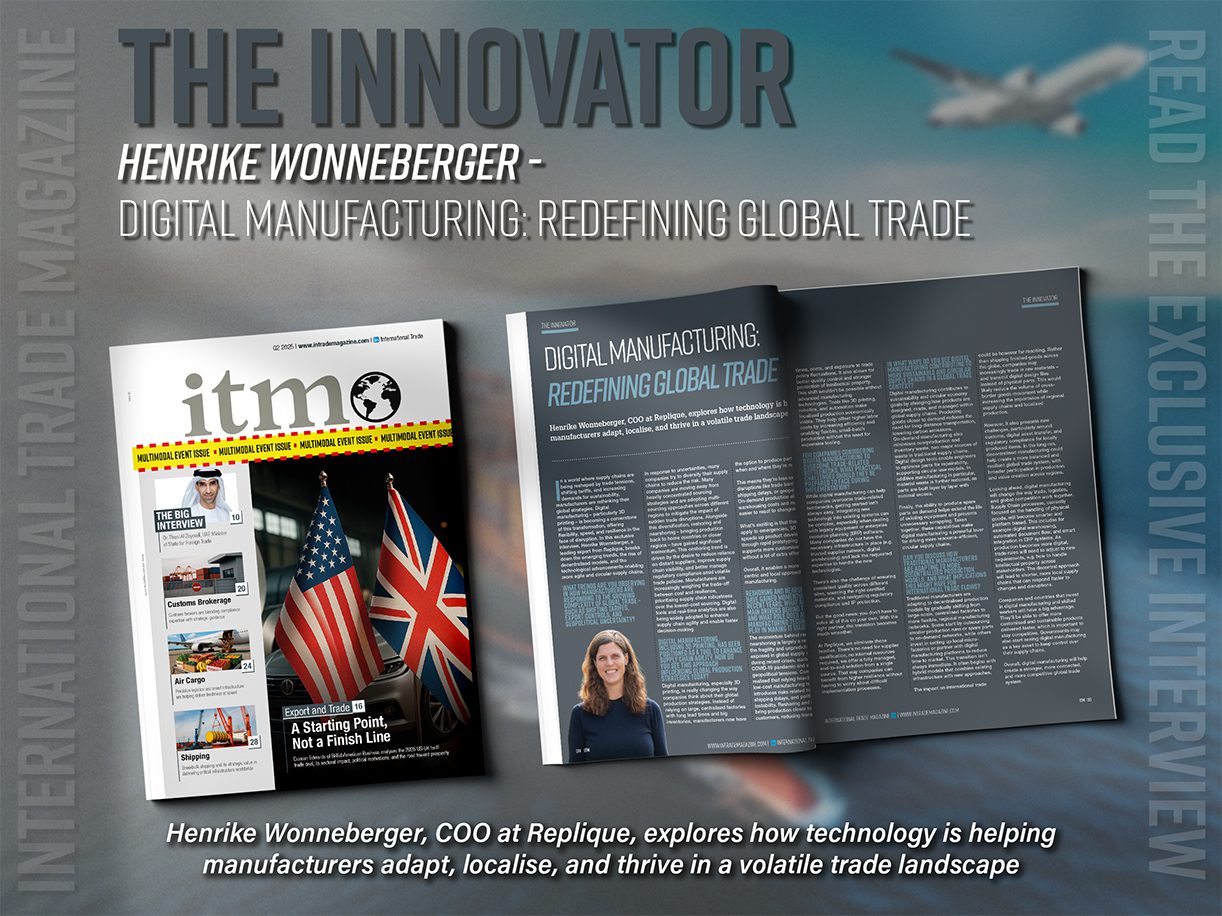

Henrike Wonneberger, COO at Replique, explores how technology is helping manufacturers adapt, localise, and thrive in a volatile trade landscape
In a world where supply chains are being reshaped by trade tensions, shifting tariffs, and increasing demands for sustainability, manufacturers are rethinking their global strategies. Digital manufacturing – particularly 3D printing – is becoming a cornerstone of this transformation, offering flexibility, speed, and resilience in the face of disruption. In this exclusive interview, Henrike Wonneberger, a leading expert from Replique, breaks down the emerging trends, the rise of decentralised models, and the technological advancements enabling more agile and circular supply chains.
What trends are you observing in how manufacturers are responding to the growing complexity of global trade – such as shifting tariffs, export controls, and geopolitical uncertainty?
In response to uncertainties, many companies try to diversify their supply chains to reduce the risk. Many companies are moving away from heavily concentrated sourcing strategies and are adopting multi-sourcing approaches across different regions to mitigate the impact of sudden trade disruptions. Alongside this diversification, reshoring and nearshoring – bringing production back to home countries or closer regions – have gained significant momentum. This onshoring trend is driven by the desire to reduce reliance on distant suppliers, improve supply chain visibility, and better manage regulatory compliance amid volatile trade policies. Manufacturers are increasingly weighing the trade-off between cost and resilience, prioritising supply chain robustness over the lowest-cost sourcing. Digital tools and real-time analytics are also being widely adopted to enhance supply chain agility and enable faster decision-making.
Digital manufacturing, including 3D printing, has been positioned as a tool to enhance supply chain agility. How do you see this approach influencing global production strategies today?
Digital manufacturing, especially 3D printing, is really changing the way companies think about their global production strategies. Instead of relying on large, centralised factories with long lead times and big inventories, manufacturers now have the option to produce parts exactly when and where they’re needed.
This means they’re less exposed to disruptions like trade barriers, shipping delays, or geopolitical risks. On-demand production also helps cut warehousing costs and makes it easier to react to changes in demand.
What’s exciting is that this doesn’t just apply to emergencies, 3D printing also speeds up product development through rapid prototyping and supports more customised products without a lot of extra effort.
Overall, it enables a more customer-centric and local approach to manufacturing.
Reshoring and nearshoring have gained momentum in recent years. What are the main drivers behind this shift, and what role does advanced manufacturing technology play in making it viable?
The momentum behind reshoring and nearshoring is largely a response to the fragility and unpredictability exposed in global supply chains during recent crises, such as the COVID-19 pandemic and escalating geopolitical tensions. Companies have realised that relying heavily on distant, low-cost manufacturing hubs introduces risks related to tariffs, shipping delays, and political instability. Reshoring and nearshoring bring production closer to end customers, reducing transportation times, costs, and exposure to trade policy fluctuations. It also allows for better quality control and stronger protection of intellectual property.
This shift wouldn’t be possible without advanced manufacturing technologies. Tools like 3D printing, robotics, and automation make localised production economically viable. They help offset higher labor costs by increasing efficiency and enabling flexible, small-batch production without the need for expensive tooling.
For companies considering digital manufacturing to overcome trade-related bottlenecks, what practical challenges should they be prepared to face during implementation?
While digital manufacturing can help companies overcome trade-related bottlenecks, getting started isn’t always easy. Integrating new technology into existing systems can be complex, especially when dealing with legacy equipment or enterprise resource planning (ERP) software. Many companies do not have the necessary infrastructure in place (e.g. trusted supplier network, digital warehousing) and lack the requested expertise to handle the new technologies.
There’s also the challenge of ensuring consistent quality across different sites, sourcing the right certified materials, and navigating regulatory compliance and IP protection.
But the good news: you don’t have to solve all of this on your own. With the right partner, the transition becomes much smoother.
At Replique, we eliminate those hurdles. There’s no need for supplier qualification, no internal resources required, we offer a fully managed, end-to-end solution from a single source. That way companies can benefit from higher resilience without having to worry about difficult implementation processes.
In what ways do you see digital manufacturing contributing to more sustainable and circular supply chains in a global trade context?
Digital manufacturing contributes to sustainability and circular economy goals by changing how products are designed, made, and managed within global supply chains. Producing goods closer to demand reduces the need for long-distance transportation, lowering carbon emissions. On-demand manufacturing also minimises overproduction and inventory waste, two major sources of waste in traditional supply chains. Digital design tools enable engineers to optimise parts for repairability, supporting circular use models. In additive manufacturing in particular, material waste is further reduced, as parts are built layer by layer with minimal excess.
Finally, the ability to produce spare parts on demand helps extend the life of existing equipment and prevents unnecessary scrapping. Taken together, these capabilities make digital manufacturing a powerful lever for driving more resource-efficient, circular supply chains.
Read the full interview in our latest issue here