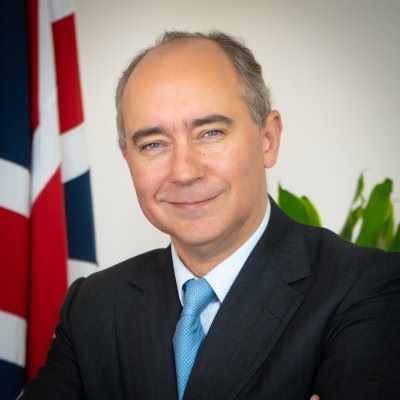

Lord Dominic Johnson explains the important work that the Department for Business and Trade are doing to help UK businesses and encourage international trade
What does your work entail as Minister of State for the Department of Business and Trade?
My role encompasses various aspects. When I break it down, the first part involves being a transactional leader and a marketer. It means going out to assist companies making significant investments in the UK. A notable example of this is the Tar Gigafactory, a remarkable success for the UK. This project, possibly the largest construction in our history, was led by my efforts, supported by an exceptional team in the Department of Business and Trade and the Office for Investment. Several colleagues, including ministers and the Prime Minister, played pivotal roles in this endeavour. Approximately 30% of my daily work involves handling companies seeking investment, often requiring financial support. We help them navigate the available capital sources, as well as assist with various aspects, such as understanding the visa process for high-potential staff.
The second part of my role revolves around leading the investment department within the Department of Business and Trade. This is a fascinating and sometimes challenging but exciting responsibility. We have around 650 staff members worldwide across the UK. My primary mission has been to complement our existing contact base with industrial capital. I’m talking about companies like Mitsubishi, Siemens, EDF, or Caterpillar, where we already have good relationships, often involving government relations departments with connections to our government system. We aim to explore what I call the “pools of capital,” which includes sovereign wealth funds, large pension funds, and significant private equity and venture funds.
The third part of my role is about influencing government decisions. I aim to position myself as the representative of business and investment interests in Whitehall. A significant portion of my time is devoted to tilting the Whitehall machine toward viewing its activities from the perspective of an investor. This role is crucial. My colleagues are receptive to the suggestions I make, derived directly from what I consider my “client base.” We work on ways to improve the planning process, the visa system, grid connectivity, and funding structures.
In summary, my role is incredibly diverse but centred around one fundamental goal: ensuring the UK becomes the premier destination for international capital globally. Every day, I assess whether my actions contribute to this outcome, allowing me to structure my activities accordingly.
How does the Department for Business and Trade support smaller companies, including SMEs and startups?
The UK government is well aware of the significance of supporting small and medium-sized enterprises. Our country offers various funding mechanisms. The British Business Bank, sitting atop a comprehensive structure of different funding mechanisms, is notably focused on channelling capital to startups and early-stage businesses, particularly in sectors related to the future economy, encompassing clean energy, life sciences, technology, and FinTech. Without this support, we wouldn’t have the innovations and products essential to maintain our economic pre-eminence.
As for the Department of Business and Trade, it does a commendable job, although there’s always room for improvement, as I’ll discuss shortly. A notable strength lies in mentoring initiatives, and we offer various programs to aid both exporters, which are important, although not my primary focus, and small businesses looking to scale up, expand, and secure the right sources of capital. From my perspective, the projects I’m involved in, such as university spinouts, exemplify how the government can facilitate the process by providing an entrepreneurial and executive framework for highly talented academics. These individuals may lack business experience or prefer to maintain their focus on their core expertise, which involves supporting them in building their business. Our approach involves a blend of diverse programs. My main focus is to secure capital to support these companies’ growth, and accomplishing this aligns with my primary goal. Simultaneously, the government as a whole is dedicated to providing practical assistance to smaller businesses, whether it’s through mentorship or by helping them find international partners for export or investment opportunities.
Apart from the challenge of obtaining capital and the need for training, what are some of the other challenges that UK businesses face?
UK businesses face a myriad of challenges beyond capital and training. These challenges include product development, growth, hiring, and navigating complex regulations. Additionally, there are industry-specific issues that need addressing, such as market competition and adapting to changes driven by global trade patterns.
While access to capital remains a consistent concern, it is important to work on reducing barriers, streamlining processes, and providing businesses with the necessary tools to navigate challenges. Furthermore, a key focus should be on cultivating an ecosystem that supports small and medium-sized enterprises (SMEs), particularly in emerging areas like clean energy, life sciences, and technology.
The government plays a role in addressing these challenges by offering funding mechanisms, mentorship programs, and support for exports. My specific focus is on getting capital into the UK, as this can have a cascading effect on SMEs and startups, but it requires a coordinated effort from all stakeholders.
You recently wrote about the UK and Kuwait’s investment partnership. What do you consider to be the most significant outcomes expected from this partnership for both nations?
The UK and Kuwait have a long-standing investment partnership, dating back to 1952. Kuwait has consistently invested in the UK, particularly in property and infrastructure projects, making a significant contribution to our economy. The most significant outcomes from this partnership are twofold.
First, Kuwait’s commitment to increasing its investment in the UK is essential. It injects capital into our economy and strengthens the perception of the UK as a stable and attractive destination for foreign investment. This is crucial for fostering economic growth and development.
Second, this partnership serves as a beacon, inspiring other countries to follow suit. When nations see that Kuwait, with its prestigious sovereign wealth fund, is deepening its ties with the UK, it encourages other countries to explore investment opportunities here. This increased international attention leads to more opportunities and capital flowing into the UK.
In summary, the UK-Kuwait investment partnership bolsters our economy, enhances our global reputation, and encourages other nations to consider the UK as a prime investment destination.
What other initiatives or deals are in the pipeline, or do you hope the UK will see in the coming years?
We have a robust pipeline of initiatives and deals aimed at strengthening the UK’s position in international trade and investment. One of my primary tasks is to establish memoranda of understanding (MOUs) with major sovereign wealth funds from countries like Bahrain, the UAE, Saudi Arabia, Singapore, Canada, and Australia. Strengthening these relationships is essential for attracting capital and investments to the UK.
I am also working on creating an ecosystem centred in the UK that will serve as the international headquarters for venture capital and corporate venture capital. This initiative is crucial for capitalising on the technological advancements that will shape our future.
Furthermore, I’m actively involved in expanding our trade networks worldwide, focusing on free trade deals with various nations, such as Korea, Canada, Mexico, India, and the GCC. These trade deals are vital for the UK’s economic growth and international prominence.
As I mentioned earlier, free trade is not a topic that garners widespread attention, and it’s essential that we, as a society, celebrate the benefits of free trade deals. The support of businesses and professionals in this endeavour is vital for the success of these agreements and the prosperity of our nation.
Read more news and exclusive features in our latest issue here.
Never miss a story… Follow us on:
International Trade Magazine
@itm_magazine
@intrademagazine
Media Contact
Joseph Clarke
Editor, International Trade Magazine
Tel: +44 (0) 1622 823 920
Email: [email protected]