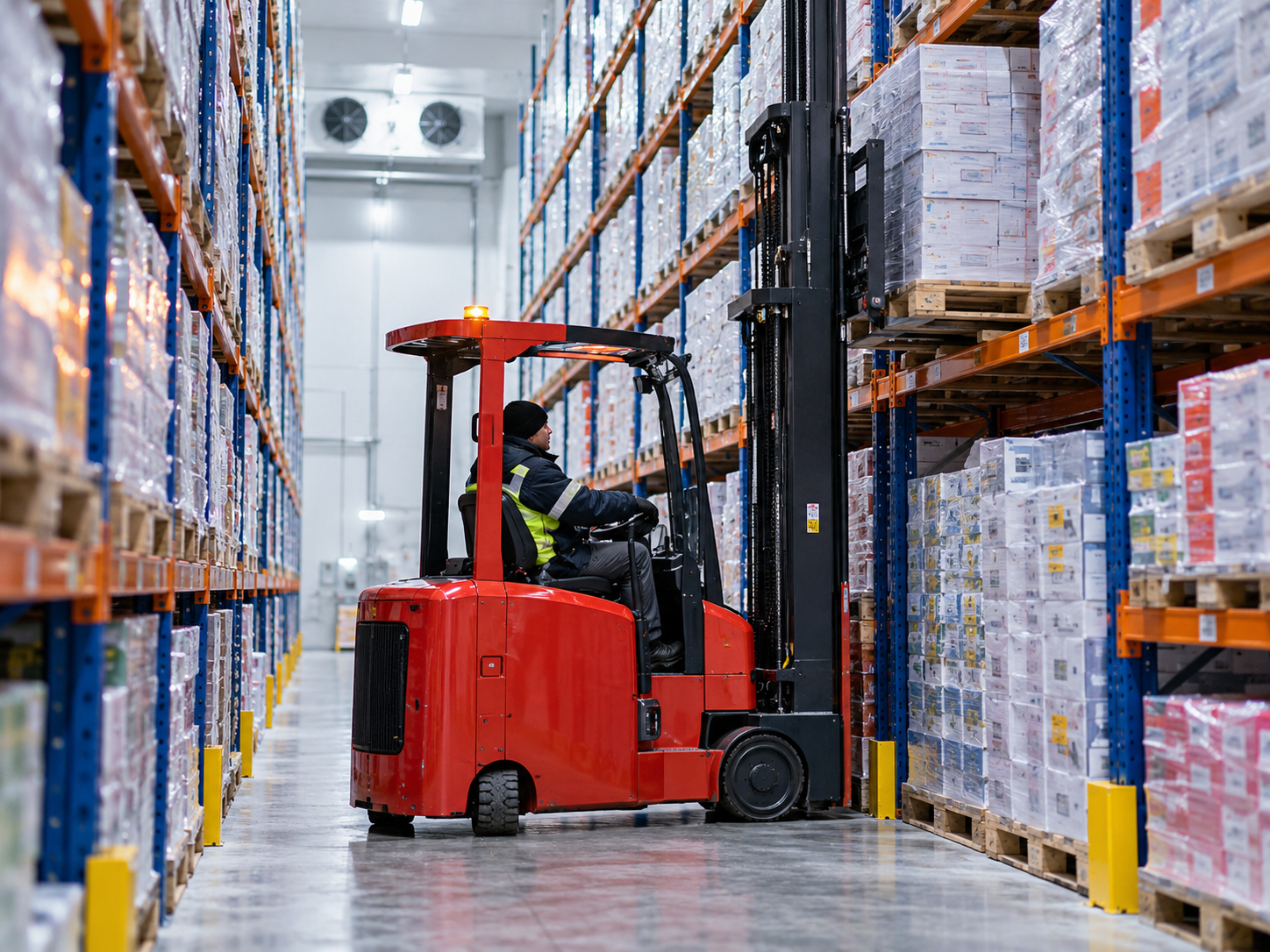

Martin Jones of Narrow Aisle explains how articulated forklift trucks can maximise space utilisation and boost performance for warehouse operators challenged by a growing demand for cold storage.
As the UK experiences a long summer of heatwaves, it is worth considering the importance of the cold storage sector. Despite having the largest cold storage capacity in Europe, the UK does indeed need even more cold store space to support successful food, retail and pharmaceutical supply chains.
Gaining more space is not always about constructing new warehouses; existing facilities can be used more purposefully. One way of doing this is through technology innovations, such as the integration of IoT and AI. It can improve operational efficiency and monitoring capabilities in cold stores. But just as important are established solutions for optimising warehouse space, such as articulated forklift trucks.
In fact, Flexi Narrow Aisle®, which has many customers who specialise in cold storage, can provide a Flexi Cold Store articulated lift truck that has been developed for continuous use down to –30 degrees centigrade.
This is good news for UK operators seeking high density storage involving narrow aisles in different types of cold stores to accommodate growing demand for perishable goods, frozen foods, online grocery or pharmaceutical products.
Perishable goods such as fresh produce, dairy products and ready-to-eat meals require chilled storage. These facilities are maintained at temperatures of between 0 and 5 degrees centigrade to preserve these increasing popular product groups.
Frozen products form another major part of the cold storage market. Operators typically store these goods at temperatures between minus 18 and minus 30 degrees centigrade.
Frozen food continues to grow in popularity because it offers a longer shelf life, convenience and less food waste. Ocado Retail Data reported an 18 percent year on year rise in frozen product sales at the end of 2025.
Almost half of UK adults also increased their frozen purchases during the previous year, with younger shoppers leading this trend. Three quarters say frozen food saves time when they are busy. Meanwhile, 73 percent believe product quality has improved in recent years. These trends point towards continued growth in demand for frozen products.
Convenience also continues to drive the UK online grocery market. The UK accounted for just over 34 percent of the European market in 2025, according to Market Data Forecast.
Statista recorded around 28.6 million UK online grocery users by March 2026. This represented growth of 5.15 percent from the previous year. Cold storage facilities play a vital role in fulfilling these orders while maintaining product quality throughout the supply chain.
Demand also extends beyond food. The pharmaceutical sector continues to introduce products that can quickly create significant requirements for temperature controlled storage. Recent examples include Covid vaccines and weight loss drugs.
Many pharmaceutical products require tightly controlled environments to protect their quality and integrity. Operators often need to maintain temperatures between 2 and 8 degrees centigrade throughout storage and distribution.
High density storage and new cold store operations
While the cold storage market continues to expand, operators face growing pressure to maximise storage density. Keeping warehouses chilled or frozen consumes significant energy and increases operating costs. Frozen facilities can require around four times more energy than conventional warehouses.
Rising energy costs make efficient use of every available square metre increasingly important. Articulated forklift trucks allow operators to introduce narrow aisle configurations and increase pallet storage density.
Flexi articulated forklift trucks can work inside freezers to place and retrieve pallets delivered by other handling equipment. Their versatile design also allows them to collect and deliver urgent customer loads directly from loading docks.
Warehouses must also provide greater pallet selectivity and support increasingly complex order assembly operations. Traditional cold stores mainly handled full pallet loads because consumers often preferred fresh food to frozen alternatives.
That pattern is changing as consumer attitudes towards frozen food improve. The increasing popularity of frozen ready meals demonstrates this shift. Cold stores therefore need configurations that support more complex picking and individual customer orders.
Operators can use very narrow aisle trucks with steel guide rails or inductive wires installed in the floor. However, steel guide rails can restrict access to important ground level picking locations. Very narrow aisles can also create problems for low level order picking.
Combining Flexi articulated forklift trucks with low level order pickers offers another approach. Flexi trucks do not require wire guidance or steel guide rails. Operators can therefore configure aisle widths around their specific order assembly requirements.
Without steel guide rails, operators can position the first rack beam at 2 metres. This configuration provides easier access for fast case picking.
Turret trucks operating within very narrow aisle racking provide another option. However, these trucks require a 5 metre wide transfer aisle, which consumes valuable cold storage space.
Operators can alternatively combine powered mobile racking with very narrow aisles served by Flexi trucks. This approach can maximise storage density across chilled and frozen chambers while maintaining access to individual pallets.
Working in the cold
Forklifts must have the correct specification for continuous operation in demanding cold storage environments. Operators can specify all Flexi Cold Store models with heated cabs. This feature supports continuous fleet operation in blast freezers and other high throughput environments.
The trucks use robust electrical and hydraulic systems designed for cold storage conditions. Zinc coatings protect the main components, while other parts also carry cold store specifications. These features allow trucks to move intermittently between cold and ambient environments.
Reliability becomes particularly important because equipment downtime can increase operating costs in cold storage facilities. Sites using Flexi trucks report improvements in both reliability and productivity.
Operators can also reduce disruption by maintaining readily available battery power. Each truck can use two heavy duty batteries supported by 6 hour chargers. While one battery powers the truck, the second battery charges.
Flexi has also developed a battery changeover system that takes around one minute to complete. Alternatively, operators can use lithium ion power to remove the need for battery changes.
Cold storage operators face stricter food safety requirements, rising energy costs and changing customer expectations. They must also respond to growing pharmaceutical exports, online grocery sales and demand for chilled and frozen food.
High density storage configurations using articulated forklift trucks can help operators address these pressures. They can increase storage density while maintaining pallet accessibility, picking flexibility and operational efficiency.