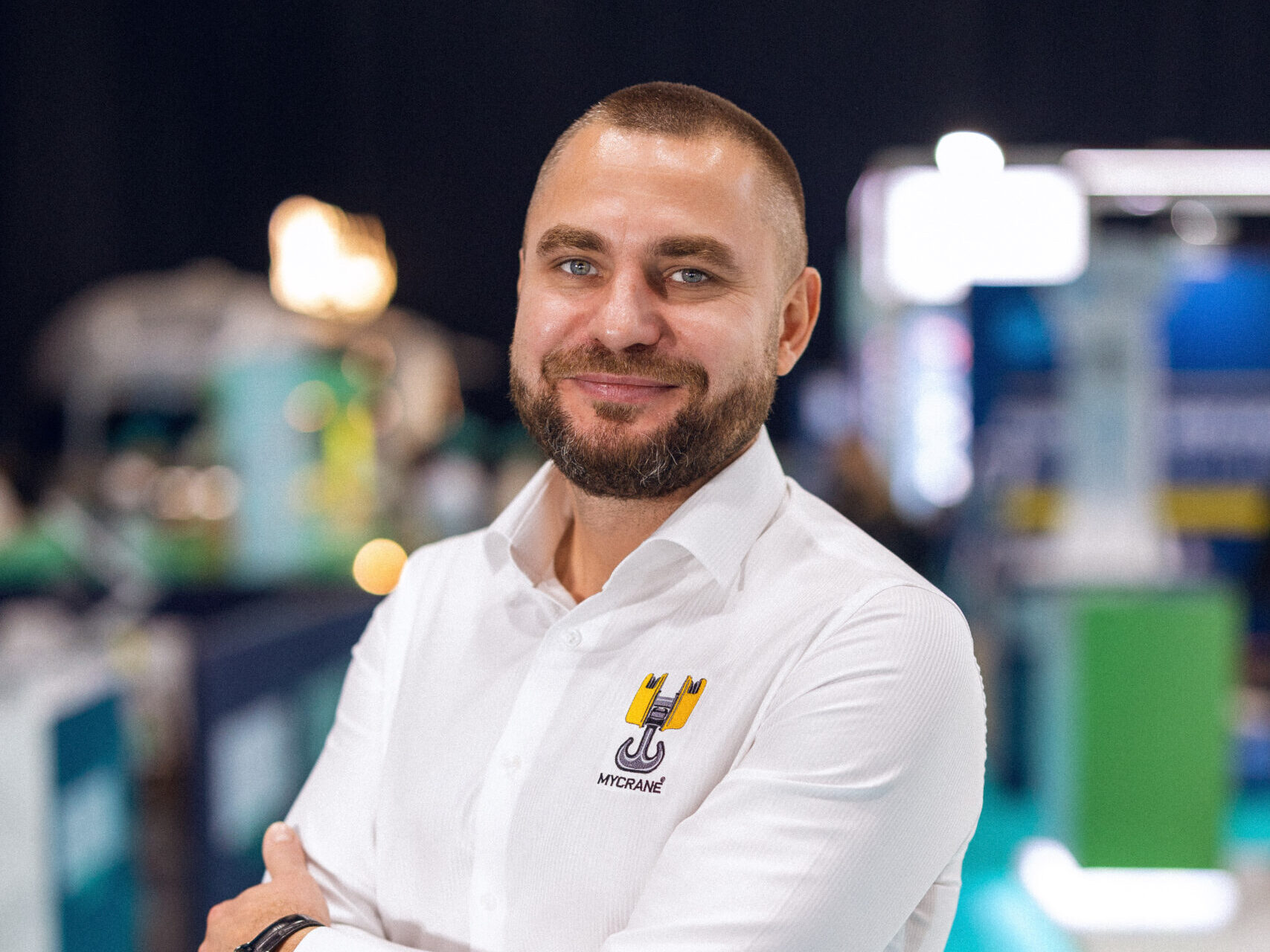

Andrei Geikalo, Founder & CEO of MYCRANE discusses how digital procurement platforms are improving visibility, reducing mobilisation delays, and changing the way cranes and heavy equipment are sourced across global logistics markets.
Please introduce yourself and MYCRANE.
I’m Andrei Geikalo, founder and CEO of MYCRANE. My background is in engineering which I studied at the Bauman Moscow State Technical University in Moscow. I then spent nearly a decade at Mammoet, starting as a yard mechanic and eventually became a commercial director. That experience gave me the knowledge and experience of crane procurement from every angle.
MYCRANE was founded in Dubai in 2021 and is the world’s first dedicated online platform for crane rental and purchase with live operations across the UAE, Saudi Arabia and India.
MYCRANE is an active procurement tool for some of the world’s most prominent contractors and EPC companies. We recently announced a significant growth in our India operations, for example, where we have over 1,000 registered clients including Larsen & Toubro, Tata, Adani Group, KP Energy, Macawaber Beekay, Birla Corp, Megha Engineering and NCC, alongside global industrial names such as Linde, Technip, thyssenkrupp and ArcelorMittal Nippon Steel.
A logical extension of our rental platform was the recent launch of MYCRANE Trading, operating from Jebel Ali Free Zone and providing customers with access to crane sales, leasing and maintenance services on a global basis.
How is the emergence of digital marketplaces changing the way lifting equipment is sourced and allocated across global logistics networks?
Fundamentally, it changes visibility. A procurement manager in Dammam or Delhi, for instance, can now see verified fleet owners and operators across multiple states simultaneously as well as comparable pricing, documented specifications, operator credentials, without the need of a single phone call.
We recently handled the rental of a 400-tonne crawler crane for a major infrastructure project in India, sourced and confirmed on-platform. By sourcing from a nearer location, which the platform made visible, the client saved more than 20% against traditional offline procurement. That saving wasn’t the result of negotiation, rather it was the result of information.
How are supply chain disruptions influencing the availability and movement of cranes and specialist lifting equipment worldwide?
In the past, the core structural problem was that the crane sector had no real market intelligence. Availability was invisible unless you knew the right people and companies relied on a handful of trusted suppliers, only to find themselves with no backup when those relationships couldn’t deliver. What we see now is procurement teams much more interested in building resilience, which means knowing what’s available across a wider market, not just who they’ve used before.
What challenges arise when moving cranes between regions with differing regulatory standards, infrastructure limitations, and transport constraints?
Every market, possibly every state, has different permitting requirements, axle load regulations, route survey obligations and certification standards. What typically causes delays is that these requirements are discovered late, usually after a supplier is selected and contracts are being drafted. The traditional process simply doesn’t surface this information early enough.
When supplier documentation, certification status and registration details are captured at the enquiry stage, you don’t eliminate the complexity of cross-border movement, but you significantly reduce the number of late surprises.
How can smaller operators and SMEs overcome the challenges of sourcing and transporting heavy equipment in a market often dominated by large fleet owners?
The core problem for smaller contractors has always been visibility, not of their own equipment, but of available supply. Without established broker relationships, a smaller EPC company or regional contractor had no reliable way to know what equipment existed, where it was, or whether it was genuinely certified. They were dependent on the same handful of suppliers as everyone else, with no fallback when those relationships couldn’t deliver.
MYCRANE addresses this directly on two levels. On the rental platform, procurement teams can now see verified fleet owners and operators across multiple markets simultaneously. They are able to see comparable pricing, documented specifications and operator credentials without the broker intermediation that historically filtered smaller buyers out of the best options. On the trading side, MYCRANE Trading gives smaller companies access to verified used equipment globally, with full inspection reports and telematics data on every unit, at transparent pricing. Whether sourcing locally or internationally, they’re accessing genuine machines through a verified process that previously required either an established network or a broker taking a margin to navigate it.
The result works in both directions. Smaller contractors reach supply they couldn’t previously access. Smaller fleet owners and operators get visibility in front of buyers they would never previously have been considered for. The platform removes the network dependency that has always disadvantaged both sides.
How are regional imbalances in crane supply and demand influencing international trading patterns and equipment relocation strategies?
There are markets where demand for specific crane classes outstrips local supply, while others have capacity sitting underutilised. Historically, matching those situations relied on knowing both markets personally. MYCRANE Trading, launched with a USD 50 million investment and operating from Jebel Ali Free Zone, exists to address this directly. We source verified used equipment globally, with full inspection reports and telematics data on every unit, through a network of verified fleet owners and operators. The price on the website is the price at the yard, showcasing transparent pricing that changes the economics of cross-regional equipment movement.
Sustainability is becoming an increasingly important consideration. How is it influencing decisions around equipment transport, reuse, and relocation?
In many markets, project timelines, cost and availability still dominate procurement decisions. But two areas show real impact. One is equipment reuse, which is extending the working life of a crane through verified maintenance records, and the second is proper inspection which is sustainable by definition.
Mobilisation efficiency matters, too. When platform data helps a client source equipment from a closer location, that’s a genuine reduction in transport emissions. The sustainability outcome is a consequence of better procurement, not a separate objective.
How can improved communication between contractors, suppliers, and logistics providers reduce delays in equipment mobilisation?
One of the biggest causes of mobilisation delays is documentation, not the crane itself. In the traditional process, much of this arrives over email when mobilisation is already supposed to be happening.
Documentation should be part of the supplier profile and available to clients before a decision is made. On a project where a crane sits on the critical path, waiting two days for a certification document can cost more than the crane rental itself.
What role do you think automation and AI will play in optimising crane allocation, routing, and redeployment?
Near-term, the most valuable application is smarter matching to use platform data on availability, capacity, location and project timelines to surface the right equipment faster. That’s achievable and we’re already moving in that direction. Longer term, dynamic redeployment, where the platform anticipates where equipment needs to move before a client has issued an enquiry, represents a logical next step when sufficient transactional data exists across multiple logistics markets. But the foundation has to be verified data: Faster matching on unverified specifications just creates the same problems more quickly.
How has industry perception of digital procurement in the crane sector changed?
When we started in 2021, the question we heard often was whether the crane industry was ready for digital procurement. We don’t hear it much any more. Our growth shows the industry was ready — it just needed the infrastructure to exist.