
As manufacturers grapple with the uncertainty of tariffs and their potential impact, many are speculating whether digital manufacturing technologies – such as additive manufacturing – might be key to overcoming these challenges. But for one CEO, it highlights a related and pressing issue: the need to invest in workforce skills.
Michael Fuller, Founder of Conflux Technology, a world-leading heat transfer and additive manufacturing (AM) company, gave us his view.
Beneath the noise about trade wars and protectionism, in the face of tariffs, the manufacturing industry is contending with rising production costs, supply chain disruption, market volatility, and shrinking export competitiveness. Meanwhile, additive manufacturing (AM) has often been hailed as the cure-all for reshoring production and shielding supply chains from the turbulence of global trade. The promise of on-demand, localized manufacturing – design a part here, print it there – seems like the perfect solution to bypass tariffs and reduce reliance on complex global supply chains. Yet in practice, advanced manufacturing is far more complex. From high-precision parts to critical aerospace components, the difference between a successful product and a failed one lies in the mastery of people who know how to turn design files into working reality.
In advanced manufacturing – whether additive, subtractive, or hybrid – digital technologies have revolutionized the way we make things. Computer-controlled milling and additive manufacturing promise to distribute production around the globe. In theory, you can design a part in one location and manufacture it in another with a simple digital file transfer. The allure of a plug-and-play approach to global production is undeniable.
But here’s the catch: it rarely works that way in practice.
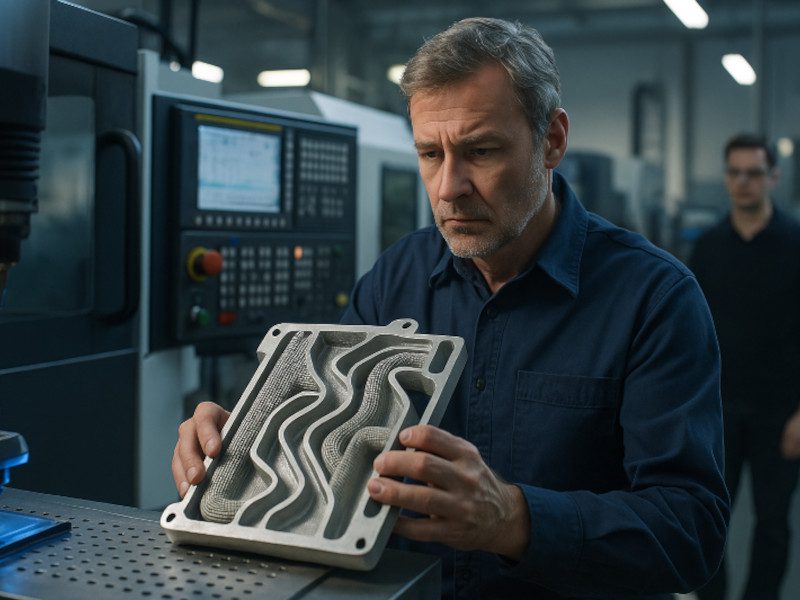
Despite decades of digital integration, the reality is that high-quality, high-precision manufacturing still depends on a tightly integrated supply chain and, most critically, on highly skilled people. While some global organisations with multiple manufacturing plants may be able to send digital files around the world and produce intricate parts, without that kind of vertical supply chain, it’s only straightforward components like brackets, washers, or gaskets that will fit into a plug-and-play production model. Manufacturing a highly complex heat exchanger, like those we produce at Conflux, demands far more. It requires a deep understanding of processes, geometry, and materials; expertise that can’t simply be downloaded from a cloud server.
When tariffs hit, companies often look to reshoring or localizing production to circumvent rising costs. But doing so is far from straightforward. Take additive manufacturing (AM) as an example. While AM offers unparalleled design freedom and the promise of reducing complexity, it comes with its own set of challenges – chief among them the need for expertise. Even with the most sophisticated AM machines, printing a component that actually performs as intended requires highly skilled engineers and operators who know how to set up, run, and troubleshoot these processes.
The hype cycles of the past decade promised plug-and-play solutions that would bring manufacturing home overnight. But what we’ve seen instead is that skills gaps stand in the way of realizing that vision. Companies have invested in the technology, only to find that the expertise to unlock its full potential is in short supply. And when they fail to upskill the workforce or recruit talent in, machines can sit idle, or worse, produce subpar parts that erode confidence in the technology.
This skills gap isn’t just about technical know-how; it’s about understanding how to design for specific processes, how to configure complex geometries, and how to manage the entire digital thread, from design through to manufacturing and quality assurance.
Tariffs can be a blunt instrument in trade policy, but they also force manufacturers to think harder about their supply chains and, by extension, their workforce. If we want to build resilient, high-quality local manufacturing capacity, we need to invest in training, development, and continuous learning.
At Conflux, we see this every day. Our heat exchanger designs, for example, are not plug-and-play solutions. They are highly customized components that serve the world’s most demanding industries – from Formula One, to hypercars, eVTOLs and aircraft – where performance, precision, and reliability are non-negotiable. Producing these parts requires both deep domain knowledge and an intimate understanding of the manufacturing process. Transferring production from one location to another isn’t just a matter of sending a file; it’s about transferring skills, processes, and know-how – a process that takes time, investment, and above all, people.
So, as we debate tariffs, let’s also talk about investing in the workforce that will make our manufacturing future possible. Tariffs may highlight the challenges, but closing the skills gap is the real opportunity – and the real solution – for building sustainable, resilient manufacturing in a globally competitive world.
Never miss a story… Follow us on:
International Trade Magazine
@itm_magazine
@intrademagazine
Media Contact
Editor, International Trade Magazine
Tel: +44 (0) 1622 823 920
Email: [email protected]