
ZF has introduced a new air disc brake for heavy-duty commercial vehicles. It has been designed to address forthcoming Euro 7 brake-particle requirements while reducing servicing demands for fleet operators.
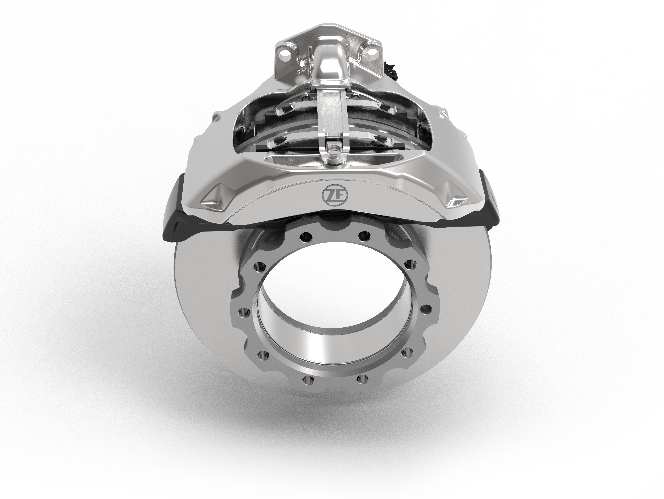
Unveiled at IAA Transportation 2026, the MAXX Uniper combines a new air disc brake design with a specially coated rotor. ZF says the combination can reduce PM10 brake-particle emissions by up to 65%. Production of the new brake is expected to begin in 2027.
Heavy-duty braking platform
MAXX Uniper provides braking torque of up to 30,000Nm and uses ZF’s single-piston air disc brake architecture.
A bi-directional adjuster regulates running clearance between the brake pad and rotor, supporting even pad wear and reducing the risk of over-adjustment. ZF has also developed a new carrier and brake-pad arrangement intended to simplify replacement during servicing.
ZF’s modular architecture allows vehicle manufacturers to apply the brake concept across different heavy-duty commercial vehicle platforms and applications.
An optional plug-and-play continuous wear sensor is also available. The replaceable sensor requires no calibration and helps operators monitor brake condition while reducing maintenance requirements.
Fleet maintenance implications
For logistics fleets, brake-particle emissions are becoming another factor to consider alongside fuel consumption, exhaust emissions and vehicle electrification.
The Euro 7 framework extends the regulatory focus beyond tailpipe emissions, making technologies that address brake wear increasingly relevant to commercial vehicle manufacturers and fleet procurement strategies.
Maintenance is another consideration. ZF’s focus on simplified pad replacement and continuous wear monitoring could help operators improve workshop planning and vehicle availability. Although, the operational benefits will ultimately depend on individual duty cycles and fleet applications.
ZF developed the MAXX Uniper for conventional, hybrid and fully electric heavy-duty vehicles, allowing fleets to use the technology as they transition between different powertrains.