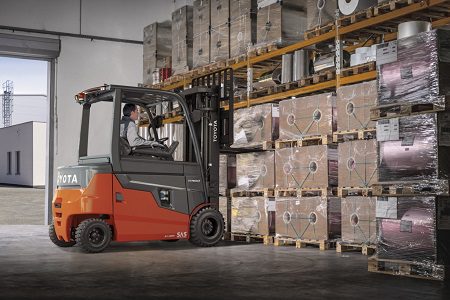

With more and more forklift truck users opting for electric-power over IC-engine driven machines when the time comes to replace or upgrade their materials handling equipment fleet, the coming years are expected to bring a clear shift away from diesel and LPG towards electric forklifts. Indeed, Toyota Material Handling expect the UK market for electric counterbalanced forklift trucks to grow by as much as 10% in the next five years. In this article, Toyota’s counterbalance specialist, Paul Bowers, considers some of the factors driving the rise of the electric-powered forklift market.
Charging ahead
According to the most reliable estimates, the forklift market has historically been split roughly 60-40 between LPG- or diesel-powered internal combustion engine (IC) trucks and battery-driven electric models – with diesel being the most dominant fuel. But the coming years are anticipated to bring a clear shift away from diesel and LPG towards electric forklifts.
At Toyota Material Handling, for example, we expect the UK market for electric counterbalanced forklift trucks to grow by as much as 10% in the next five years as more and more truck users opt for electric-power over IC-engine driven machines when the time comes to replace or upgrade their fleets.
The rise of the electric lift truck can be attributed to a number of different factors – including heightened environmental concerns, rising fuel prices and greater awareness of staff welfare.
Advances in battery technology, such as the further development of lithium-Ion and to a lesser extent (for now) hydrogen fuel cells, are also leading to greater interest in electric power, while the wide ranging changes to intralogistics processes brought about by the seemingly relentless increase in internet shopping tend to favour electric trucks too.
Of course, environmental issues have been on the corporate agenda for many years but recent talk of the introduction of a ‘carbon emissions tax’ has seen a sharp increase in the truck users that include like-for-like carbon emissions comparisons as part of their forklift fleet purchasing process. IC-engine trucks rarely come top of the class in such tests, which will not be a surprise to many given that electric-powered trucks have always been perceived to have the edge over the IC-engine alternative in all matters ‘green’.
But it would be wrong to conclude that the electric truck market is only growing because diesel sales are in decline: recent developments in technology mean the electric lift truck is now a highly sophisticated product that offers real business benefits to the broadest range of users. And, furthermore, today’s battery-driven forklifts are capable of performing highly effectively within the type of harsh environments that historically only diesel trucks would be considered suitable for.
Perhaps the single biggest technological advance behind the upsurge in electric truck sales is the arrival of the lithium-ion battery. While lead acid remains by far the dominant battery type within the electric-powered forklift market, sales of Lithium-ion forklifts have been on a sustained upward curve for some time.
Although it is estimated that in the region of 90% of all electric forklifts in operation throughout the world are still running on lead acid batteries, the Lithium-Ion solution has now become well established as a viable alternative. Indeed, nearly a quarter of all Toyota electric-powered forklift trucks ordered for delivery in the UK now feature Lithium-Ion battery (LiB) technology.
Today, Lithium-ion is revolutionising the way that some companies operate their intralogistics processes. Lithium-ion batteries have the ability to be recharged in as little as one hour – which increases a truck’s overall availability. One hour’s charging will give in the region of 4 to 5 hours of operating time. Also, as these batteries allow for opportunity charging, trucks can be recharged anywhere by the operator during breaks in a shift or other periods of downtime. As a result, there is no need to swap batteries – so dedicated charging rooms and spare batteries are not necessary.
Hydrogen fuel cells are also emerging as another viable alternative to lead acid batteries. At the present time, Hydrogen only becomes financially realistic where in the region of 90+ trucks are in operation at one location due to the significant investment required in hydrogen generation and storage systems, so the potential user market is currently somewhat limited.
But large fleet operators are keen to embrace the technology and Toyota Hydrogen fuel cell-powered forklifts are already operating at sites across the Nordic region and Europe as well as Australia. Meanwhile in the automotive sector Toyota’s hydrogen-powered Mirai is at the forefront of a new age of hydrogen fuel cell cars that deliver long distance zero-emissions driving.
Of course, as with any new development, when the product matures the price will drop and there is every reason to believe hydrogen fuel cell power will be within reach of every business with a forklift fleet in the not-too-distant future.
But, despite the worldwide rush to eliminate – or at least minimise – the use of fossil fuels and the myriad benefits that electric trucks offer users in terms of running costs, productivity, reduced pollution – it is unlikely that we are witnessing the last days of the diesel-powered lift truck.
There are currently still numerous applications, particularly where extra-heavy lifting is involved and truck capacities of 8 tonnes and over are required, where a diesel forklift remains the best option. This might not be the case in 10 years’ time though.
Companies considering switching from IC- to electric-engine forklift trucks, should always discuss their options with their MHE supplier who will be able to assess the benefits of going electric for every type of operation.
Media contact
Rebecca Morpeth Spayne,
Editor, International Trade Magazine
Tel: +44 (0) 1622 823 922
Email: [email protected]