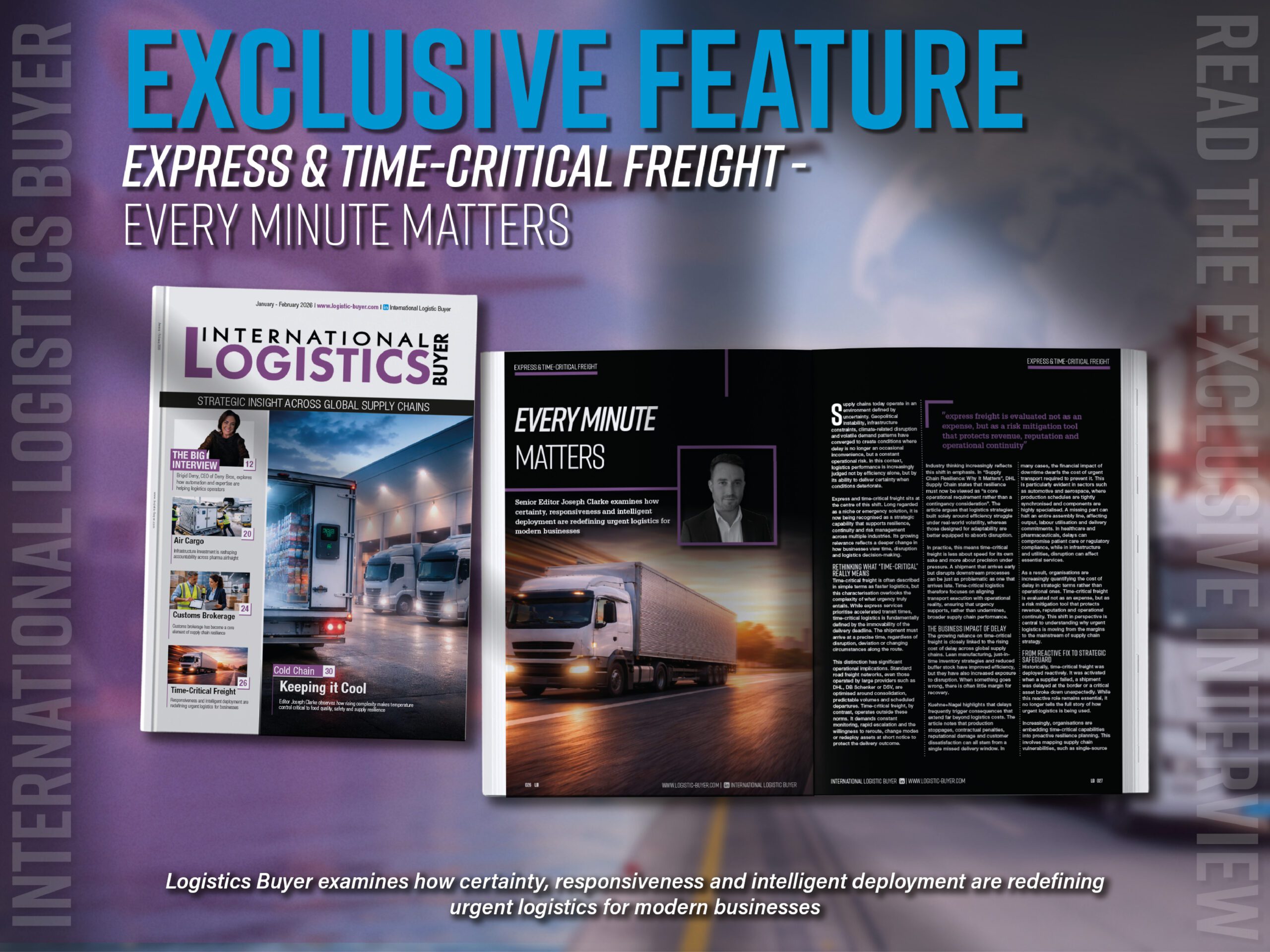

Senior Editor Joseph Clarke examines how certainty, responsiveness and intelligent deployment are redefining urgent logistics for modern businesses
Supply chains today operate in an environment defined by uncertainty. Geopolitical instability, infrastructure constraints, climate-related disruption and volatile demand patterns have converged to create conditions where delay is no longer an occasional inconvenience, but a constant operational risk. In this context, logistics performance is increasingly judged not by efficiency alone, but by its ability to deliver certainty when conditions deteriorate.
Express and time-critical freight sits at the centre of this shift. Long regarded as a niche or emergency solution, it is now being recognised as a strategic capability that supports resilience, continuity and risk management across multiple industries. Its growing relevance reflects a deeper change in how businesses view time, disruption and logistics decision-making.
Rethinking What “Time-Critical” Really Means
Time-critical freight is often described in simple terms as faster logistics, but this characterisation overlooks the complexity of what urgency truly entails. While express services prioritise accelerated transit times, time-critical logistics is fundamentally defined by the immovability of the delivery deadline. The shipment must arrive at a precise time, regardless of disruption, deviation or changing circumstances along the route.
This distinction has significant operational implications. Standard road freight networks, even those operated by large providers such as DHL, DB Schenker or DSV, are optimised around consolidation, predictable volumes and scheduled departures. Time-critical freight, by contrast, operates outside these norms. It demands constant monitoring, rapid escalation and the willingness to reroute, change modes or redeploy assets at short notice to protect the delivery outcome.
Industry thinking increasingly reflects this shift in emphasis. In “Supply Chain Resilience: Why It Matters”, DHL Supply Chain states that resilience must now be viewed as “a core operational requirement rather than a contingency consideration”. The article argues that logistics strategies built solely around efficiency struggle under real-world volatility, whereas those designed for adaptability are better equipped to absorb disruption.
In practice, this means time-critical freight is less about speed for its own sake and more about precision under pressure. A shipment that arrives early but disrupts downstream processes can be just as problematic as one that arrives late. Time-critical logistics therefore focuses on aligning transport execution with operational reality, ensuring that urgency supports, rather than undermines, broader supply chain performance.
The Business Impact of Delay
The growing reliance on time-critical freight is closely linked to the rising cost of delay across global supply chains. Lean manufacturing, just-in-time inventory strategies and reduced buffer stock have improved efficiency, but they have also increased exposure to disruption. When something goes wrong, there is often little margin for recovery.
Kuehne+Nagel highlights that delays frequently trigger consequences that extend far beyond logistics costs. The article notes that production stoppages, contractual penalties, reputational damage and customer dissatisfaction can all stem from a single missed delivery window. In many cases, the financial impact of downtime dwarfs the cost of urgent transport required to prevent it. This is particularly evident in sectors such as automotive and aerospace, where production schedules are tightly synchronised and components are highly specialised. A missing part can halt an entire assembly line, affecting output, labour utilisation and delivery commitments. In healthcare and pharmaceuticals, delays can compromise patient care or regulatory compliance, while in infrastructure and utilities, disruption can affect essential services.
As a result, organisations are increasingly quantifying the cost of delay in strategic terms rather than operational ones. Time-critical freight is evaluated not as an expense, but as a risk mitigation tool that protects revenue, reputation and operational continuity. This shift in perspective is central to understanding why urgent logistics is moving from the margins to the mainstream of supply chain strategy.
Read the full article in our latest issue here: Jan – Feb 2026 Issue – International Logistics Buyer Magazine