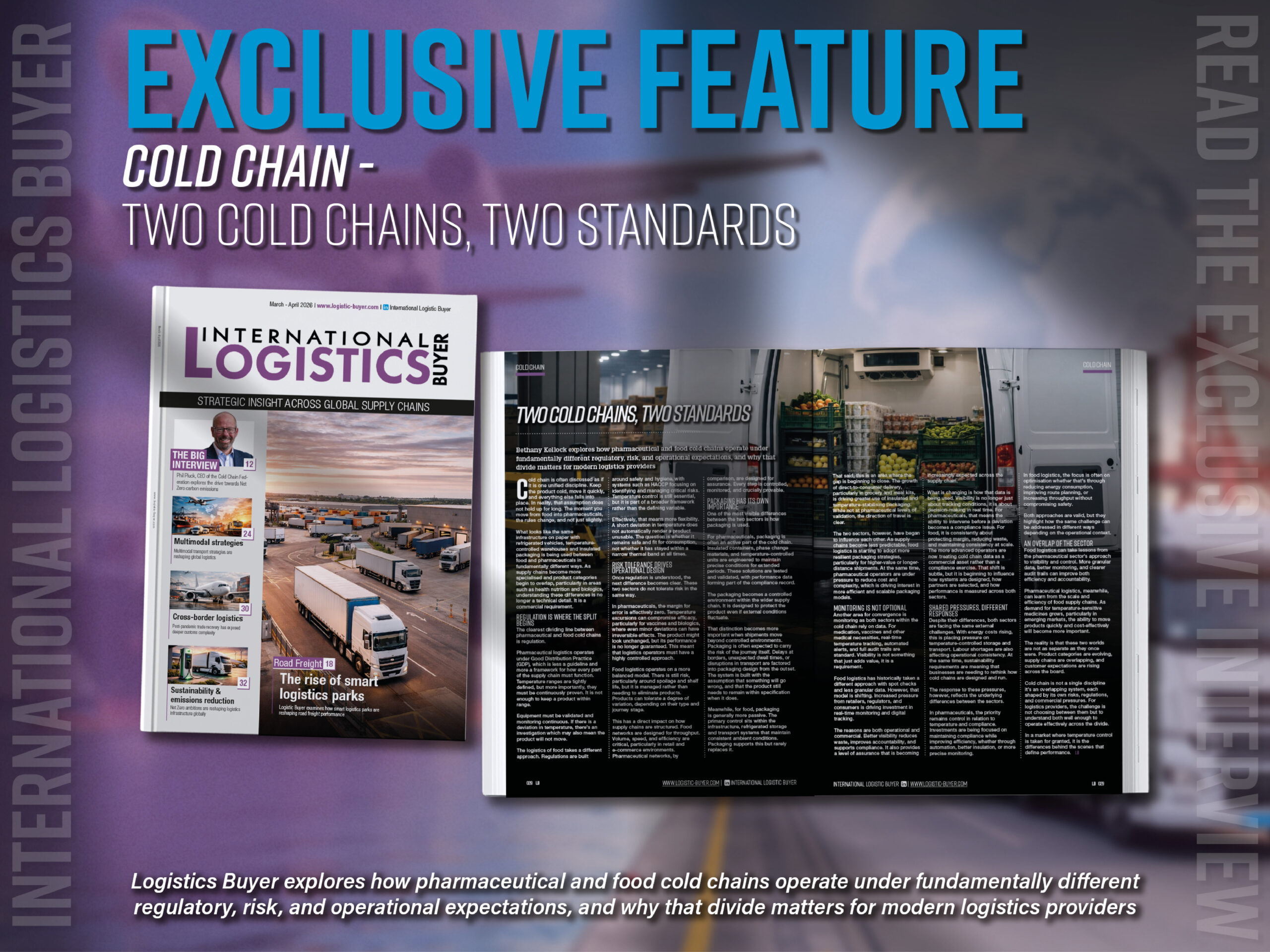

Bethany Kellock explores how pharmaceutical and food cold chains operate under fundamentally different regulatory, risk, and operational expectations, and why that divide matters for modern logistics providers.
Cold chain is often discussed as if it is one unified discipline. Keep the product cold, move it quickly, and everything else falls into place. In reality, that assumption does not hold up for long. The moment you move from food into pharmaceuticals, the rules change, and not just slightly.
What looks like the same infrastructure on paper with refrigerated vehicles, temperature-controlled warehouses and insulated packaging is being used between food and pharmaceuticals in fundamentally different ways. As supply chains become more specialised and product categories begin to overlap, particularly in areas such as health nutrition and biologics, understanding these differences is no longer a technical detail. It is a commercial requirement.
Regulation is where the split begins
The clearest dividing line between pharmaceutical and food cold chains is regulation.
Pharmaceutical logistics operates under Good Distribution Practice (GDP), which is less a guideline and more a framework for how every part of the supply chain must function. Temperature ranges are tightly defined, but more importantly, they must be continuously proven. It is not enough to keep a product within range.
Equipment must be validated and monitoring continuous. If there is a deviation in temperature, there’s an investigation which may also mean the product will not move.
The logistics of food takes a different approach. Regulations are built around safety and hygiene, with systems such as HACCP focusing on identifying and managing critical risks. Temperature control is still essential, but it is part of a broader framework rather than the defining variable.
Effectively, that means more flexibility. A short deviation in temperature does not automatically render a product unusable. The question is whether it remains safe and fit for consumption, not whether it has stayed within a narrow thermal band at all times.
Risk tolerance drives operational design
Once regulation is understood, the next difference becomes clear. These two sectors do not tolerate risk in the same way.
In pharmaceuticals, the margin for error is effectively zero. Temperature excursions can compromise efficacy, particularly for vaccines and biologics, where even minor deviations can have irreversible effects. The product might look unchanged, but its performance is no longer guaranteed. This meant that logistics operators must have a highly controlled approach.
Food logistics operates on a more balanced model. There is still risk, particularly around spoilage and shelf life, but it is managed rather than needing to eliminate products. Products can tolerate a degree of variation, depending on their type and journey stage.
This has a direct impact on how supply chains are structured. Food networks are designed for throughput. Volume, speed, and efficiency are critical, particularly in retail and e-commerce environments. Pharmaceutical networks, by comparison, are designed for assurance. Every step is controlled, monitored, and crucially provable.
Packaging has its own importance
One of the most visible differences between the two sectors is how packaging is used.
For pharmaceuticals, packaging is often an active part of the cold chain. Insulated containers, phase change materials, and temperature-controlled units are engineered to maintain precise conditions for extended periods. These solutions are tested and validated, with performance data forming part of the compliance record.
The packaging becomes a controlled environment within the wider supply chain. It is designed to protect the product even if external conditions fluctuate.
That distinction becomes more important when shipments move beyond controlled environments. Packaging is often expected to carry the risk of the journey itself. Delays at borders, unexpected dwell times, or disruptions in transport are factored into packaging design from the outset. The system is built with the assumption that something will go wrong, and that the product still needs to remain within specification when it does.
Meanwhile, for food, packaging is generally more passive. The primary control sits within the infrastructure, refrigerated storage and transport systems that maintain consistent ambient conditions. Packaging supports this but rarely replaces it.
That said, this is an area where the gap is beginning to close. The growth of direct-to-consumer delivery, particularly in grocery and meal kits, is driving greater use of insulated and temperature-stabilising packaging. While not at pharmaceutical levels of validation, the direction of travel is clear.
The two sectors, however, have began to influence each other. As supply chains become less predictable, food logistics is starting to adopt more resilient packaging strategies, particularly for higher-value or longer-distance shipments. At the same time, pharmaceutical operators are under pressure to reduce cost and complexity, which is driving interest in more efficient and scalable packaging models.
Monitoring is not optional
Another area for convergence is monitoring as both sectors within the cold chain rely on data. For medication, vaccines and other medical necessities, real-time temperature tracking, automated alerts, and full audit trails are standard. Visibility is not something that just adds value, it is a requirement.
Food logistics has historically taken a different approach with spot checks and less granular data. However, that model is shifting. Increased pressure from retailers, regulators, and consumers is driving investment in real-time monitoring and digital tracking.
The reasons are both operational and commercial. Better visibility reduces waste, improves accountability, and supports compliance. It also provides a level of assurance that is becoming increasingly expected across the supply chain.
What is changing is how that data is being used. Visibility is no longer just about tracking conditions, it is about decision-making in real time. For pharmaceuticals, that means the ability to intervene before a deviation becomes a compliance issue. For food, it is consistently about protecting margin, reducing waste, and maintaining consistency at scale. The more advanced operators are now treating cold chain data as a commercial asset rather than a compliance exercise. That shift is subtle, but it is beginning to influence how systems are designed, how partners are selected, and how performance is measured across both sectors.
Shared pressures, different responses
Despite their differences, both sectors are facing the same external challenges. With energy costs rising, this is placing pressure on temperature-controlled storage and transport. Labour shortages are also affecting operational consistency. At the same time, sustainability requirements are meaning that businesses are needing to rethink how cold chains are designed and run.
The response to these pressures, however, reflects the underlying differences between the sectors.
In pharmaceuticals, the priority remains control in relation to temperature and compliance. Investments are being focused on maintaining compliance while improving efficiency, whether through automation, better insulation, or more precise monitoring.
In food logistics, the focus is often on optimisation whether that’s through reducing energy consumption, improving route planning, or increasing throughput without compromising safety.
Both approaches are valid, but they highlight how the same challenge can be addressed in different ways depending on the operational context.
An overlap of the sector
Food logistics can take lessons from the pharmaceutical sector’s approach to visibility and control. More granular data, better monitoring, and clearer audit trails can improve both efficiency and accountability.
Pharmaceutical logistics, meanwhile, can learn from the scale and efficiency of food supply chains. As demand for temperature-sensitive medicines grows, particularly in emerging markets, the ability to move products quickly and cost-effectively will become more important.
The reality is that these two worlds are not as separate as they once were. Product categories are evolving, supply chains are overlapping, and customer expectations are rising across the board.
Cold chain is not a single discipline it’s an overlapping system, each shaped by its own risks, regulations, and commercial pressures. For logistics providers, the challenge is not choosing between them but to understand both well enough to operate effectively across the divide.
In a market where temperature control is taken for granted, it is the differences behind the scenes that define performance.